How Did the Egyptians Beliefs About the Afterlife Influence Their Art and Architecture
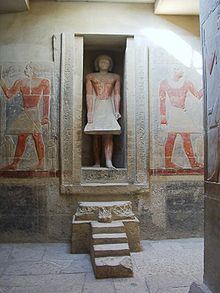
Aboriginal Egyptian afterlife beliefs were centered effectually a variety of circuitous rituals that were influenced by many aspects of Egyptian culture. Organized religion was a major contributor, since it was an of import social practise that bound all Egyptians together. For instance, many of the Egyptian gods played roles in guiding the souls of the dead through the afterlife. With the evolution of writing, religious ideals were recorded and quickly spread throughout the Egyptian customs. The solidification and get-go of these doctrines were formed in the creation of afterlife texts which illustrated and explained what the dead would need to know in guild to complete the journey safely.
Egyptian religious doctrines included three afterlife ideologies: conventionalities in an underworld, eternal life, and rebirth of the soul. The underworld, also known as the Duat, had but one archway that could be reached past traveling through the tomb of the deceased. The initial image a soul would exist presented with upon entering this realm was a corridor lined with an array of fascinating statues, including a variation of the hawk-headed god, Horus. The path taken to the underworld may have varied between kings and common people. After entry, spirits were presented to some other prominent god, Osiris. Osiris would determine the virtue of the deceased'south soul and grant those deemed deserving a peaceful afterlife. The Egyptian concept of 'eternal life' was ofttimes seen as being reborn indefinitely. Therefore, the souls who had lived their life elegantly were guided to Osiris to be born again.[1]
In order to achieve the ideal afterlife, many practices had to be performed during ane's life. This may have included acting justly and following the beliefs of Egyptian creed. Additionally, the Egyptians stressed the rituals completed after an individual'south life has ended. In other words, information technology was the responsibility of the living to carry out the final traditions required then the dead could promptly run across their concluding fate. Ultimately, maintaining high religious morals by both the living and the dead, as well every bit complying to a variety of traditions, guaranteed the deceased a smoother transition into the underworld.
Funeral practices [edit]
At that place were many challenges the dead had to face before they were able to enter into the final stages of the afterlife. Even so, through the support of the living, the dead had admission to the protection and knowledge they would need to be reborn in the netherworld.
Tombs [edit]
The blueprint and scale of Egyptian burial tombs varied from period to menstruum, even though their function remained the same. While near tombs were built during the lifetime of the person it was meant for, Egyptian tombs were constructed to house the body of the expressionless, but too functioned to transmit the soul to the underworld.[ii] Well-nigh of what was found in a tomb depended on the status of the person buried within it. Still, in gild to assistance the dead, most tombs were decorated with texts meant to aid guide the deceased's soul to the afterlife, something that was attainable to all.[3]
Afterlife texts [edit]
Throughout the centuries, the Egyptian people busy their tombs and coffins with religious spells and texts hoping to help the dead in the afterlife. As Egyptian civilization developed, these texts also evolved and became more complex and extensive in nature.
Pyramid Texts [edit]

Pyramid Text within the burying pyramid of Teti I
The Pyramid Texts were the beginning religious spells to be carved into the walls of majestic ancient Egyptian pyramids. Beginning in the Old Kingdom period, these texts were used exclusively by the Egyptian pharaohs to decorate the walls of their tombs. However, Egyptian Queens and high-ranking government officials shortly began to use Pyramid Texts in their burial tombs as well. The purpose of these texts were to help the pharaoh successfully complete his journeying through the afterlife, by carrying noesis to the deceased nearly the paths he should have and the dangers he might face along the fashion.[4]
Coffin Texts [edit]
In the Middle Kingdom period the Pyramid Texts were replaced by the Coffin Texts. The Coffin Texts were spells that were inscribed into the coffins of the expressionless. They were meant to protect the deceased in the afterlife and provide them with the transformation magic they would need along their journey. These Bury Texts were generally more attainable, providing the common people of Egypt the opportunity to attain a proper afterlife. It is also of import to note that the collection of Coffin Texts known every bit The Volume of Two Means functioned as the earliest manual to the afterlife.[five]
Book of the Dead [edit]
The Book of the Dead was an extensive collection of spells that included material from both the Pyramid Texts and the Coffin Texts. In the New Kingdom catamenia, the Book of the Expressionless was normally recorded on papyrus. However, it could also be found on the tomb walls, coffins and the wrappings of mummies. Similar the Coffin Texts, the spells illustrated inside the Book of the Expressionless were used by anybody. These spells offered communication, protection and knowledge to the dead as they journeyed through the netherworld.[6]
Books of the Netherworld [edit]

The 11th hr of the book Amduat
The Books of the Netherworld contained multiple texts that provided the deceased with a description of the underworld and served as a guide to aid the dead during their terminal journey. Since the deceased were ofttimes seen replicating the rebirth bicycle of Ra as they traveled through the afterlife, these texts primarily focused on the second half of the sun god'south journey, which took him through the underworld at night. The earlier Books of the Netherworld, which include the Amduat and the Volume of Gates, divided their narratives into twelve parts, symbolizing the twelve hours the sunday god spent in the underworld. Later books such every bit the Volume of Caverns and the Book of the World used a more sectionalized approach when presenting their narratives. All of these books too contained complex illustrations of the netherworld, which could oft be seen etched into coffins and the walls of burying tombs.[vii]
Books of the Heaven [edit]
The Books of Sky consisted of 3 afterlife texts titled, the Book of Nut, the Book of Day and the Volume of Night. Carved into the ceiling of tombs these texts emphasized the role the goddess Nut played in the Egyptian afterlife.[eight]
Coffins [edit]
Coffins in Egyptian culture date back to the One-time Kingdom. During this era, coffins were relatively simple; they were equilateral makings with minor details. These included 3 openings, one that the Ka was intended to pass through and 2 that represented eyes. Nevertheless, every bit time passed coffins and their structures evolved. Past the New Kingdom, coffins had not only become more pop around the surface area just were distributed for auction. The deceased'south torso was now represented by the bury as it held a shape and was decorated with features that resembled the individual inside it.[nine] The deceased were as well often depicted in white clothes, considering information technology represented the soul'south purity after it had passed through judgement, in the Hall of Maat.[10] Additionally, the orientation of the deceased was very important to ancient Egyptians. In early on periods, the body would take laid promptly on their side with their head directed to the south. This afterwards shifted and with the body flat on its back, the northward became a more favorable position for the expressionless'south head to prevarication.[11]
Mummification Procedure [edit]
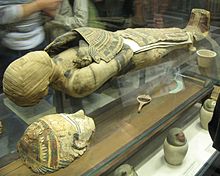
Mummification was a practice that the aboriginal Egyptians adopted considering they believed that the body needed to be preserved in order for the expressionless to exist reborn in the afterlife.[12] Initially, Egyptians thought that like Ra, their physical bodies, or Khat, would reawaken after they completed their journey through the underworld.[xiii] One time the Egyptians realized that the bodies of their expressionless would eventually decay, they started to see the remains of the dead as a vessel for the deceased'south spirit. The body was dismembered and wrapped in bandages to safeguard it, if the soul decided to return.[14]
Funeral offerings [edit]
Many Egyptians considered the tomb to be a home for the expressionless, so it was customary to get out offerings virtually the body of the deceased.[15] Egyptians believed that even after death, 1'due south spirit would alive on considering the life force was a separate entity that could detach itself from the body. This life strength was named the Ka, and was considered to be one part of what the Egyptian believed to be the immortal soul. The Ba was some other office of the soul that had increased mobility and dwelled within the Ka.[sixteen] Offerings that were left for the expressionless included clothing and valuable ornaments; the most important offer, nevertheless, was food,[17] considering even though the Ka was separated from the body, information technology could however starve.[16]
Journey to the afterlife [edit]
Ancient Egyptians theorized the passage to the afterlife in a series of stages. The commencement stage was believed to encompass the vehicle of transportation, which would eventually direct their departed souls to immortality. Individuals were subjected to a multitude of passages; but the pick of route was not theirs, it was dependent on their status. The aspect that was almost universally influential in determining what passage was taken was 1'south position among their leaders. Despite the differences betwixt voyagers, behavior concerning the afterlife were highly reliant on religious ideologies. For example, early people often used faith to understand, as well as relate to, natural occurrences since scientific discipline had non yet defined everyday incidents. To demonstrate, in that location was no justification for the sun'southward orbit, so religious myths redefined and answered the questions prehistoric people had. Yet, since natural incidences were explained by religious beliefs, other realms of creed mimicked the natural patterns of life. For instance, the general ideology associated with the path to the underworld was believed that every bit night overshadowed the land, the deceased would begin their journeying. And with the rising of the dominicus, a new day was non just thought to have begun, but a new life besides.[18]
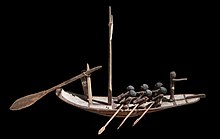
An example of a model gunkhole
Gunkhole passages to the underworld were strictly reserved for pharaohs who had died. The Egyptian sun god, Ra, was believed to travel to the underworld by gunkhole as the sun set. As a way to mimic Ra's daily expedition, the ancient people of Egypt would construct model boats, ranging in many sizes in which they would bury alongside their pharaohs. For example, next to the Pyramid of Khufu, researchers uncovered Khufu transport, a gunkhole the size of traditional ships, which displayed not just the farthermost devotion Egyptians had for their leader, merely their dedication to obtaining eternity for all. In other words, a neat deal of the requirements for the deceased to properly reach the underworld rested on the living. In society for the pharaoh to arrive at his terminal destination, his people had to construct a variety of boats to ensure his deviation. As a result, communities had to come together to support each other, otherwise their perspective of immortality, as well as their beliefs, would end indefinitely. Therefore, commitment to helping others achieve eternity was a vital component to Egyptian culture, as demonstrated by the gallant boats buried with their rulers.[19]
Additionally, an alternate vehicle for entrance to the underworld was the bury. While kings oftentimes used coffins in addition to, or in exchange of the boat belief, everyday citizens had less choice. Therefore, this method was more universal while alluding to a different, more than frequent path of entry. To compare, while passages by boat directed the deceased to the sunday god Ra, coffins were thought to guide individuals to the heaven goddess Nut. Each coffin was uniquely attributed to the person who rested in it. In other words, every coffin was subject to a variety of interpretations, all of which were intended to promote the deceased in obtaining eternity.[19]
However, non all who died were presented with the opportunity to travel to the underworld. Since the living were obligated to ensure that the deceased could travel to the afterlife, it was likewise in their control to eliminate one'due south risk in achieving eternity. Therefore, the living had an array of options that prevented a second life to an unworthy private who had died. The near famous included decapitation, which when executed, "killed a person twice". As a result, the second death associated with decapitation was too assumed to have annihilated the chance at another life. Equally noted in Egyptian texts, this instance was incredibly feared, simply happened most often to those who rebelled or disobeyed the king.[20]
Judgment of the expressionless [edit]

To the ancient Egyptians, the judgment of the dead was the process that allowed the Egyptian gods to judge the worthiness of the souls of the deceased. Deeply rooted in the Egyptian belief of immortality, judgment was one of the nigh important parts of the journeying through the afterlife. As such, many variations of judgment scenes announced in the Egyptian afterlife texts. Each soul that entered the afterlife was handled individually during judgment. Once the deceased finished their journey through the underworld, they arrived at the Hall of Maat. Here their purity would be the determining factor in whether they would be allowed to enter the Kingdom of Osiris.[21]
The deceased'southward showtime job was to correctly address each of the 40-two Assessors of Maat by proper name, while reciting the sins they did not commit during their lifetime.[22] This process allowed the dead to demonstrate that they knew each of the judges' names or Ren and established that they were pure, and gratis of sin. Later on confirming that they were sinless, the deceased was presented with the balance that was used to weigh their heart against the feather of Maat.[23] Anubis was the god ofttimes seen administering this examination. If the deceased's heart balanced with the plumage of Maat, Thoth would record the result and they would exist presented to Osiris, who admitted them into the Sekhet-Aaru. However, if their centre was heavier than the feather, it was to exist devoured past the Goddess Ammit, permanently destroying the soul of the deceased.[24]
Rebirth [edit]
There were numerous ways for Egyptians to secure their fate. Many of the actions Egyptian people took after death were to influence the god'south decision in allowing for some other life.
After judgement, entities were thought to render to the Mother Goddess' womb. During this stage, the soul meets its old body that is restored. To demonstrate, in the Book of Expressionless at that place is a series of lines that read as follows, "I unite your limbs, I concur your discharges together, I environs your mankind, I drive abroad the fluids of your decay, I sweep away your b3w, I wipe away your tears, I heal all your limbs, each beingness united with the other; I surroundings y'all with the work of the weaving goddess, I complete you and form you every bit Re."[25] The conventionalities continues equally the nude being approaches the Goddess and enters her womb as her son. To compare, this dogma is deeply related to the birth of the sun god Ra, who enters the goddess'due south womb every night, and is reborn as the sun rises.[26] Ra's relation to the afterlife is very continued through the religious components that justify the ascension and setting of the lord's day.[18]
Ultimately, the immortality desired by aboriginal Egyptians was reflected in endless lives. By doing worthy deeds in their current life, they would be granted a second life for all of eternity.
Gender [edit]
According to Egyptologist Kathlyn Thou. Cooney,[27] ancient Egyptian women were forced to redefine their gender past encompassing more masculine features. Osiris, who was the ultimate ruler of the underworld, was applauded for his incredible superiority as a effect of his virility. Additionally, the overall theme associated with gods continued their male attributes to resurrection, and goddesses were much more than vigilant. This credo was conspired from original doctrines, which denoted the overall creator a male. Statues and other forms of display made significant discover of their creator's masculine qualities, more specifically pointing out his erect penis. Therefore, to appease their god's preferences women's tombs and coffins displayed male qualities. Examples of male modifications included name combinations, in which women engraved "Osiris" earlier their own proper name on their coffins. This demonstrated the collaboration of women with a god who was capable of rebirth, because alone their gender restricted them. [28]
Sekhet-Aaru [edit]
Sekhet-Aaru, the "Field of Reeds", was the terminal destination for all souls who had been granted rebirth. This concept evolved in the Fifth Dynasty.[29] Sekhet-Aaru was essentially thought to be paradise and encompassed this visualization. The Field of Reeds was visualized as a very lush region, filled with waterfalls among other natural wonders.[30] Egyptian images, such as the Papyrus of Nebseni, depicted the land as being divided into numerous sections. Each segmentation was imagined to resemble island structures, in which travel by gunkhole is necessary.[31]
Those who were granted access to the Field of Reeds included both gods and righteous souls. The fertility of the state was greatly emphasized every bit this possessed two of the major rewards in obtaining immortality: access to the Nile, and the ability to farm foods. As a upshot, the deceased ate and drank the same delicacies devoured by their gods. In turn, this promoted the conventionalities that past obtaining immortality, individuals also accumulated aspects that resembled gods. Additionally, a 3rd notable honor of residing in Sekhet-Aaru was the means of communication. The deceased were able to convey thoughts to one another, the gods, and those they had previously lost.[29]
Run across also [edit]
- Ancient Egyptian religion
- Aboriginal Egyptian formulation of the soul
- Aboriginal Egyptian funerary practices
References [edit]
- ^ Mojsov, Bojana (2001). "The Aboriginal Egyptian Underworld in the Tomb of Sety I: Sacred Books of Eternal Life". The Massachusetts Review. 42 (4): 489–506. JSTOR 25091798.
- ^ Morenz, Siegfried (1960). Egyptian Organized religion. Ithaca, New York: Cornell University Press. pp. 194–201.
- ^ Amenta, Alessia (2002). "The Egyptian Tomb as a House of Life for the Afterlife". Egyptological Essays on State and Society: 18–26.
- ^ Hornung, Erik (1999). The Ancient Egyptian Books of the Afterlife. Ithaca, New York: Cornell Academy Press. pp. 1–6.
- ^ Hornung, Erik (1999). The Aboriginal Egyptian Books of the Afterlife. Ithaca, New York: Cornell University Press. pp. 7–11.
- ^ Hornung, Erik (1999). The Ancient Egyptian Books of the Afterlife. Ithaca, New York: Cornell University Press. pp. 13–22.
- ^ Hornung, Erik (1999). The Ancient Egyptian Books of the Afterlife. Ithaca, New York: Cornell Academy Press. pp. 26–111.
- ^ Hornung, Erik (1999). The Aboriginal Egyptian Books of the Afterlife. Ithaca, New York: Cornell University Press. pp. 112–135.
- ^ "Artifacts: Mummy Cases, Coffins, and Sarcophagi, Mummification, Online Exhibits, Exhibits, Spurlock Museum, U of I". world wide web.spurlock.illinois.edu . Retrieved 2018-04-xxx .
- ^ Cooney, Kathlyn M. (2010). "GENDER TRANSFORMATION IN DEATH: A Instance Written report of Coffins from Ramesside Period Egypt". About Eastern Archaeology. 73 (4): 230. doi:x.1086/NEA41103940. JSTOR 41103940. S2CID 166450284.
- ^ Raven, Maarten J. (2005). "Egyptian Concepts on the Orientation of the Human Body". The Periodical of Egyptian Archaeology. 91: 37–53. doi:x.1177/030751330509100103. JSTOR 3822392. S2CID 162109010.
- ^ Budge, Wallis. Egyptian Religion: Egyptian Ideas of the Future Life. New York: Bong Publishing Company. pp. 188–189.
- ^ Budge, Wallis. Egyptian Religion: Egyptian Ideas of the Time to come Life. New York: Bell Publishing Company. p. 194.
- ^ Budge, Wallis. Egyptian Religion: Egyptian Ideas of the Time to come Life. New York: Bell Publishing Company. pp. 188–200.
- ^ Morenz, Siegfried (1960). Egyptian Religion. Ithaca, New York: Cornell University Press. p. 202.
- ^ a b Budge, Wallis. Egyptian Religion: Egyptian Ideas of the Future Life. New York: Bong Publishing Visitor. p. 190.
- ^ Morenz, Siegfried (1960). Egyptian Religion. Ithaca, New York: Cornell University Press. p. 201.
- ^ a b Janák, Jiří (2003). "Journeying to the Resurrection. Chapter 105 of the Book of the Dead in the New Kingdom". Studien zur Altägyptischen Kultur. 31: 193–210. JSTOR 25152890.
- ^ a b Taylor, John H. (2001–2004). Death and the Afterlife in Aboriginal Egypt. University of Chicago Printing. ISBN9780226791647.
- ^ Picardo, Nicholas S. (2007). ""Semantic Homicide" and the So-chosen Reserve Heads: The Theme of Decapitation in Egyptian Funerary Faith and Some Implications for the Old Kingdom". Journal of the American Enquiry Center in Egypt. 43: 221–252. JSTOR 27801614.
- ^ Budge, Wallis. Egyptian Religion: Egyptian Ideas of the Future Life. New York: Bell Publishing Company. pp. 136, 152.
- ^ Coogan, Michael D. (2013). A Reader of Aboriginal Almost Eastern Texts: Sources for the Study of the Old Testament,"Negative Confessions". New York: Oxford University Press. pp. 149–150.
- ^ Budge, Wallis. Egyptian Religion: Egyptian Ideas of the Futurity Life. New York: Bell Publishing Company. pp. 161–162.
- ^ Coogan, Michael D. (2013). A Reader of Aboriginal Near Eastern Texts: Sources for the Study of the Old Testament,"The Weighting of the Heart". New York: Oxford University Press. pp. 150–154.
- ^ Hays, Christopher B. (2012). ""My Beloved Son, Come and Rest in Me": Chore'southward Return to His Mother's Womb (Job 1:21a) in Light of Egyptian Mythology". Vetus Testamentum. 62 (iv): 607–621. doi:x.1163/15685330-12341088. JSTOR 23496681.
- ^ Budge, Sir Ernest Alfred Wallis (1901). The Book of the Expressionless: An English Translation of the Chapters, Hymns, Etc., of the Theban Recension, with Introduction, Notes, Etc. Open Court Pub.
female parent.
- ^ Cooney, Kathlyn (Kara). "Gender Transformation in Death: A Case Study of Coffins from Ramesside Period Egypt".
- ^ Cooney, Kathlyn (Kara). "Gender Transformation in Death: A Case Study of Coffins from Ramesside Period Egypt".
- ^ a b Budge, East. A. Wallis (2013-02-20). Egyptian Ideas of the Afterlife. Courier Corporation. ISBN9780486158679.
- ^ Bonacker, Wilhelm (1950). "The Egyptian "Volume of the Two Means"". Imago Mundi. 7: 5–17. doi:x.1080/03085695008591952. JSTOR 1149949.
- ^ Budge, E. A. Wallis (1908). Eyptian Ideas Of The Future Life.
bermudezodevidis1959.blogspot.com
Source: https://en.wikipedia.org/wiki/Ancient_Egyptian_afterlife_beliefs

Post a Comment for "How Did the Egyptians Beliefs About the Afterlife Influence Their Art and Architecture"